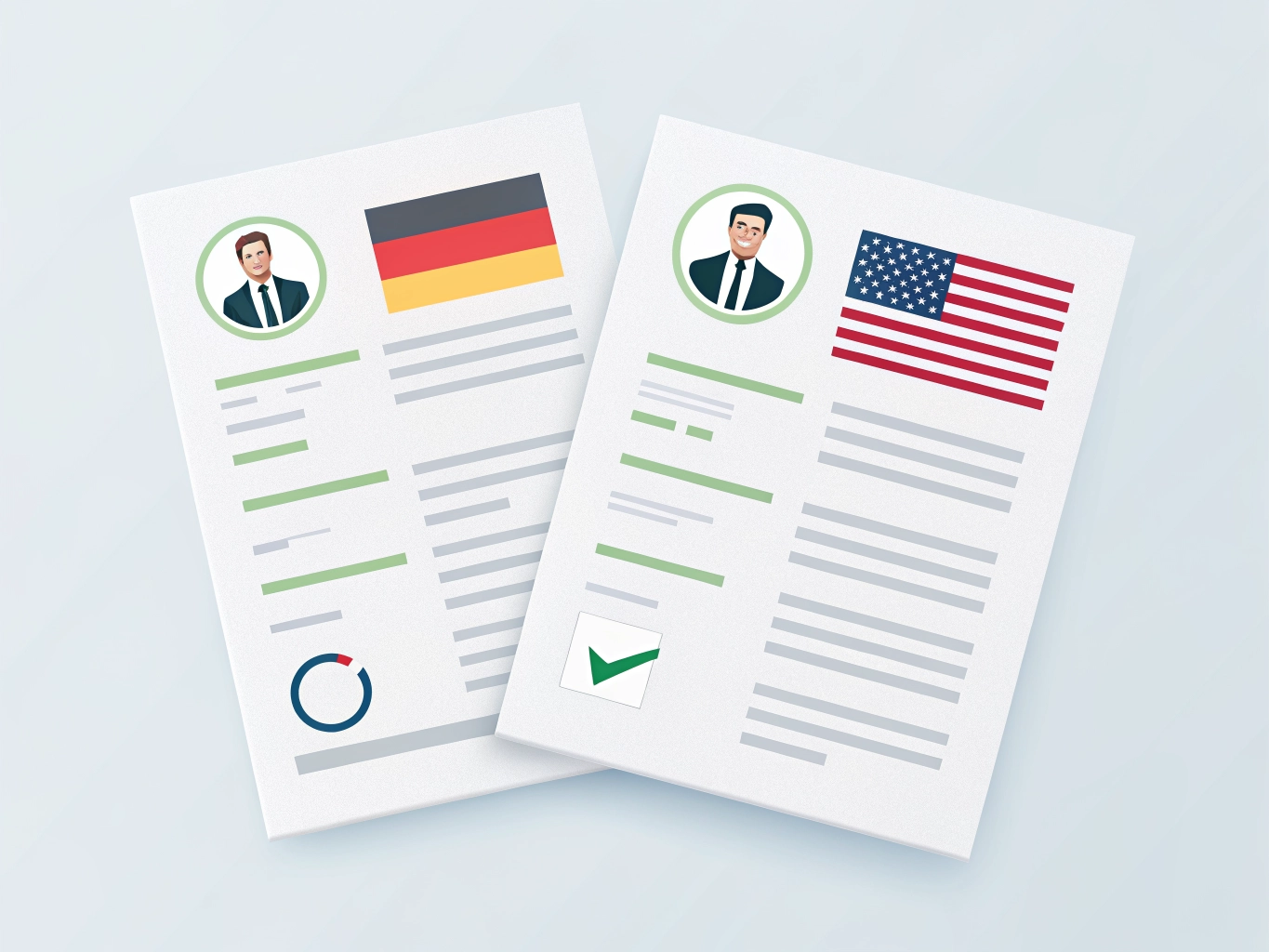
If you’ve ever prepared a resume for an American company and are now applying for jobs in Germany, it can be tempting to simply translate the document into German and send it as is. This is one of the most common reasons strong candidates don’t even make it past the initial screening: the recruiter doesn’t see a problem with you — they see a document that doesn’t match the expectations of the local market.
The German and American approaches to resumes differ not just cosmetically, but fundamentally: what is considered appropriate, what is excessive, and what should actually be included in the document. Let’s look at seven key differences and what you should do about them.
1. Length: From One Page to Two or Three
In the US, there is an unwritten rule that a resume should fit on one page, or two at most if you have 10+ years of experience. In Germany, a Lebenslauf that is 2–3 pages long is perfectly normal and not a sign that you don’t know how to be concise.
The reason lies in the different approaches: an American resume is a pitch, while a German CV is more like a dossier. Employers expect a complete and structured overview of your career rather than a highly polished sales presentation.
What to do: Don’t be afraid to describe your experience in more detail than you normally would. But more detail doesn’t mean less structure: German CVs follow a strict, predictable format (see point 4).
2. Photo on Your Resume
For the American market, including a photo on your resume is almost taboo. It is associated with the risk of discrimination based on appearance, age, or race, and many US HR departments ask candidates to remove photos from their application documents.
In Germany, a photo is still often expected, although it is not formally required. This is especially true in traditional industries and among more conservative employers. In startups and international companies, it is becoming less important.
What to do: If you are applying to a conservative German company — such as a bank, engineering firm, or public-sector organization — a professional photo is probably worth considering. For an IT startup or international company, you can generally opt for a resume without a photo and see how the market responds.
3. Personal Information: How Much Should You Disclose?
American resumes generally avoid personal information: no age, marital status, or even full address — usually just the city is enough. This is once again related to anti-discrimination practices: employers are not supposed to see information that could influence a biased hiring decision.
In Germany, a Lebenslauf has traditionally included the date of birth, and sometimes marital status and a full address. These details have historically been part of the standard document structure rather than something unusual.
What to do: For Germany, you can include your date of birth and city of residence without it looking out of place. Marital status is optional and is increasingly omitted even by German candidates.
4. Structure: Flexible Format vs. Strict Order
American resumes allow more creative freedom in terms of structure: you can start with a summary, highlight key achievements first, or arrange sections according to what best presents your profile.
German resumes follow a much more predictable template:
- personal information,
- professional experience (in reverse chronological order, without unexplained gaps),
- education,
- skills and languages,
- date and signature at the end.
German recruiters can scan information quickly precisely because they expect to find it in familiar places. An unconventional structure is not necessarily interpreted as “creative” — more often, it simply makes the document harder to navigate.
What to do: Don’t reinvent the wheel. Stick to the standard section order. In the German market, predictability works in your favor.
5. Career Gaps
In the US, a gap in your resume is not ideal, but it is not necessarily a disaster either: a short explanation in the cover letter can often address the issue.
In Germany, career gaps tend to attract more attention. A period with no explanation — whether it involved unemployment, education, parental leave, or relocation — can raise questions. The expectation is that your entire timeline should be accounted for. If you took a break, it is better to state it explicitly: parental leave, training, caring for a family member, relocation, etc.
What to do: Don’t leave unexplained gaps in your timeline. Even a single line such as “2022–2023: Relocation and German language studies (B2 level)” is much better than leaving the period blank.
6. Achievements vs. Responsibilities
The American style strongly encourages candidates to speak in terms of results: not “responsible for sales,” but “increased sales by 34% within six months.” Numbers, metrics, and measurable outcomes are standard.
German employers also value results, but there is generally less emphasis on an aggressive sales-oriented presentation. It is perfectly acceptable — and often preferable — to describe your responsibilities more factually, without excessive self-promotion. An overly promotional tone can come across as insincere.
What to do: Keep the specifics — numbers are always a plus — but remove overly promotional phrases such as “outstanding results” or “unparalleled professional.” Facts matter more than adjectives.
7. Cover Letter
In the US, cover letters are increasingly optional, and many companies don’t even read them.
In Germany, however, the Anschreiben can still be an important part of an application, especially in traditional industries. It is a separate, substantive document rather than a formal two-line addition to your resume.
What to do: Don’t skip this step when applying for jobs in Germany, even if you are used to ignoring cover letters when applying to American companies. We’ll break down the structure of an effective Anschreiben in a future article.
Checklist: Adapting Your Resume for the German Market
- Use 2–3 pages instead of one
- Decide whether a photo is appropriate for the company and industry
- Include your date of birth and city of residence
- Follow the standard German section order
- Account for all periods in your career and avoid unexplained gaps
- Describe achievements factually, using numbers where possible, without excessive marketing language
- Prepare a separate cover letter (Anschreiben)
Conclusion
The difference between a German CV and an American resume is ultimately a difference in market expectations, not in the quality of your experience. A candidate with a strong background can receive rejections simply because their document speaks to recruiters in the “wrong language” — even when the translation itself is perfectly accurate.
If you have already applied for jobs in Germany and aren’t sure whether your resume meets local expectations, it is worth reviewing it against current market standards before sending out more applications. This is one of those cases where 20 minutes spent adapting your document can save you weeks of waiting for responses that never come.