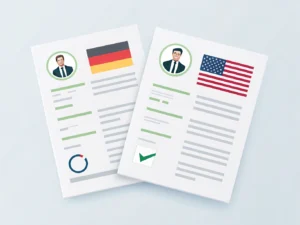
And yet, in Germany, it goes quiet — no rejection, no feedback, just silence.
That’s rarely about your experience. Far more often, it’s because the document itself doesn’t read
as a Lebenslauf to the person screening it.
German recruiters are trained to scan a very specific structure, and anything that departs from it
gets read as careless rather than creative. The good news is that fixing this has nothing to do with
your qualifications — it’s a formatting problem, and formatting problems are solvable in an afternoon.
Why a “Normal” Resume Doesn’t Translate
In the US, UK, or much of the CIS, a resume is expected to sell you — a punchy summary, achievement-driven
bullets, sometimes a splash of personality in the design. The German Lebenslauf comes from a different
tradition: it’s closer to a formal record than a pitch. Recruiters expect it to be scannable, complete,
and chronologically airtight, with no unexplained gaps between dates.
This means the same document that looked confident and modern elsewhere can look evasive or unfinished
to a German HR manager — not because they doubt you, but because the document isn’t answering the
questions they’re trained to ask first.
What to Cut
The Summary or Objective Statement
A top-of-page paragraph explaining your career goals is common elsewhere but largely unnecessary here.
German Lebensläufe let the timeline speak for itself. If you want to frame your profile, a short
“Profil” section of 2–3 lines is acceptable, but keep it factual, not promotional.
First-Person Language
“I led a team of five” becomes “Leitung eines fünfköpfigen Teams” — Lebensläufe are typically written
in a clipped, noun-based style rather than full first-person sentences. It reads as more professional,
not less warm.
“References Available Upon Request”
This line is assumed and therefore redundant. If you want to include references, name them directly
with contact details in a separate section — otherwise leave the line out entirely.
Decorative Design Elements
Icons, colored sidebars, and creative fonts are common in North American and CIS résumé templates.
In Germany, a clean, conservative, mostly black-and-white layout is still the safer default, especially
for corporate, public-sector, and traditional Mittelstand employers.
What to Add
A “Persönliche Daten” Block
Directly under your name and contact details, German Lebensläufe traditionally include a short block
with date and place of birth, and sometimes nationality. This is changing — younger companies and
international teams often skip it entirely — but for traditional employers it’s still expected. Marital
status and number of children are increasingly considered outdated and are safe to leave out regardless
of employer type.
A Photo — Sometimes
The professional photo is a genuinely regional quirk: still common in traditional German companies,
increasingly optional or discouraged in international and tech-forward ones. When in doubt, check
how the company presents itself online — a startup site in English is a signal you can skip it.
An Explicitly Continuous Timeline
Every gap of more than a month or two should be labeled with something — even “Elternzeit,” “Reise,”
or “Sprachkurs.” An unlabeled gap reads as something being hidden, even when nothing is.
Signature and Date at the Bottom
A line with the city and date, traditionally followed by a handwritten or digital signature, is a
small but noticeable detail that signals familiarity with local convention.
Lebenslauf Structure at a Glance
| Section | Standard in Germany | Common Mistake |
|---|---|---|
| Header | Name, contact info, sometimes photo and Persönliche Daten | Missing phone number or German-reachable address |
| Berufserfahrung | Reverse chronological, no gaps, company + role + dates | Functional (skills-first) format instead of chronological |
| Ausbildung | Degrees, institutions, dates, sometimes thesis topic | Missing exact dates or degree title translation |
| Kenntnisse / Skills | Languages with CEFR level, IT skills, certifications | Vague self-ratings like “good” instead of a scale |
| Footer | Place, date, signature line | Omitted entirely |
Conclusion
None of this means your experience needs reshaping — it means the container around it does.
A Lebenslauf that follows local convention lets a recruiter find what they’re looking for in the
first ten seconds, and that’s often the difference between an interview invitation and silence.
Once the structure is right, your actual qualifications can finally do the talking.